On the second day of lab, I looked at Poetry: A Magazine of Verse (October-March 1924/25; vol. 25) and The Dial (April 1928, vol. 84, #4). I filled out my worksheet on the Poetry magazine, but frankly it was a boring read and I was not particularly compelled to think about it anymore. I think the more contemporary issues of Poetry have a lot more going for them — obviously my read of the volume was more skimming than immersive, but that being said the issue felt very traditional and scholarly (though not inaccessible, at least for me, which was kind of surprising). Contemporary issues are a lot more fun and exciting. So I’m going to write about the fascination of the human figure in the art I saw during my reading of The Dial.
In a way, it makes sense. The Dial is very tied to the modernist movement during the time period that my issue was from (being edited by Marianne Moore, of all people!). As we have talked in class, modernism in literature is characterized by “…humility, concentration, and gusto” (Norton Anthology of Modern and Contemporary Poetry, Volume 1: Modern Poetry; pg. 994). Though the essay that phrase comes from is, indeed, about freedom and persuasion, due to Moore’s titanic standing within the movement of modernism, it seems to me as if everything she writes comes to say something on the movement, even if it is minute. To apply these characteristics of persuasive text to the art I have posted below might seem like a stretch, however I intend in this post to explain to you first why this application is useful and interesting and then to explain what the application produces.
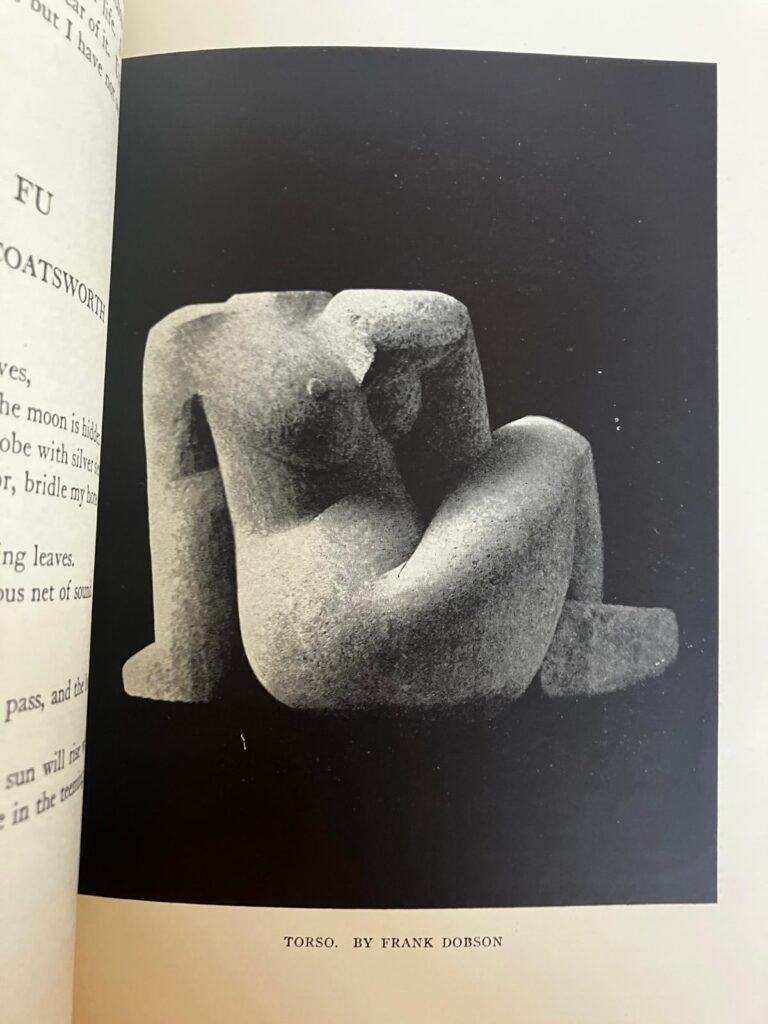
Let’s start with humility. In this essay, Moore defines humility in a similar way to how she defines words in Tender Buttons — by skirting around the subject until you manage to figure it out for yourself. “Humility, indeed, is armor, for it realizes that it is impossible to be original, in the sense of doing something that has never been thought of before” (Norton; 995). In this sense, it is easy to say that both the sculpture and the drawing have humility. There is not much in the world of humans written, created, and thought about more than the human body. Almost everything we do has to do with it. We are animals. Subject to the means of being animals. I wake up because my body needs it, I eat because my body needs it, I fuck because my body likes it, I move because my body needs it, I sleep because my body needs it. Almost everyone, I assume, thinks of their body. The body is not an original subject.
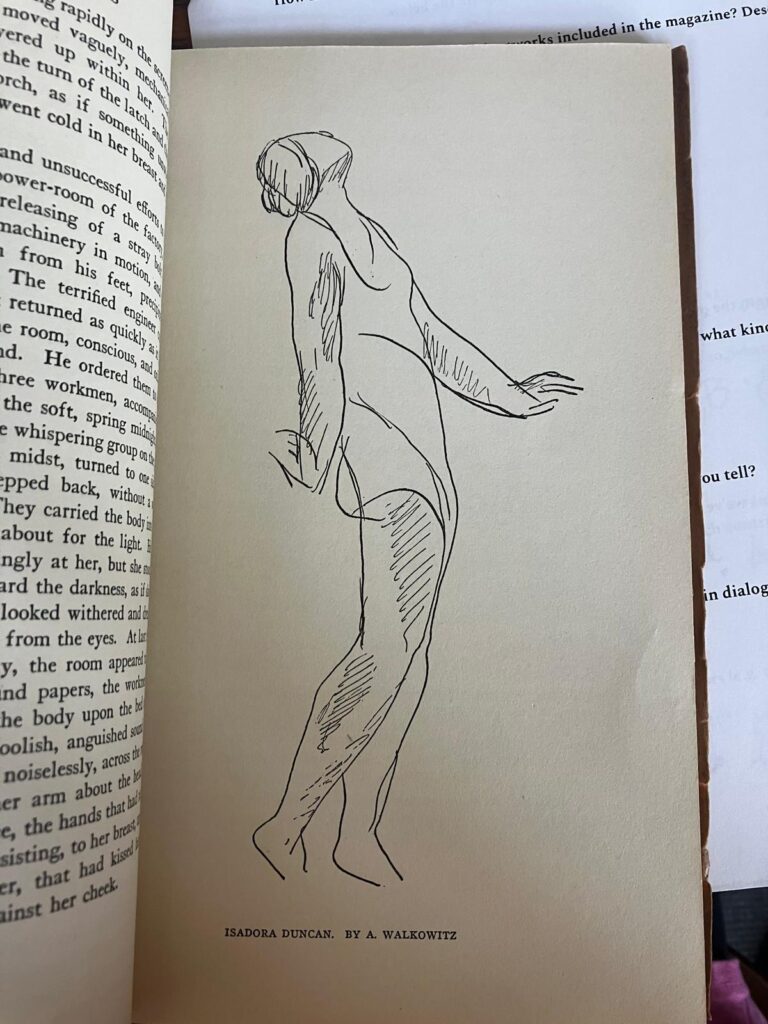
There is concentration in this work, too. The narrowing down of the art to its most essential pieces: the sculpture is just a torso, portion of legs, portions of arms. This means I can think about why the art has been concentrated in this way. The drawing concentrates on the full body, but the full body in movement. I can feel the figure tilting one way or another, swaying perhaps as if in a breeze, hands out for balance. I concentrate while engaging with this drawing on the way the figure moves; or rather, would move if they were moving. There is also the notation of shadow on their body, helping us concentrate further on where they are moving to. The light interacts with the form in a way that tells me the light source is coming from above, yet the thigh closer to the viewer, which might be left unshaded in other artists’ other drawings, is shaded in this one, signaling to me that it is moving out of the light, backwards. The calf, however, is also shaded, signaling that the move is not complete yet.
Finally, we move to gusto. Moore, at the end of “Humility, Concentration, and Gusto” writes “humility is an indispensable ally, enabling concentration to heighten gusto” (Norton; 1000). One could dwell on these words for a long, long time, but the key of my analysis lies in this: because these pieces of art are so concentrated down to their most fundamental actions and the visual representations of such, they obtain the ephemeral characteristic of gusto. They are executed gutsy-ly, without (obvious) hesitation.
“The body is not an original subject.” Excellent phrase/observation, Smith. And your application of Moore’s “Humility, Concentration, Gusto” is inspired. (One note — Tender Buttons was written by Stein, not Moore!)