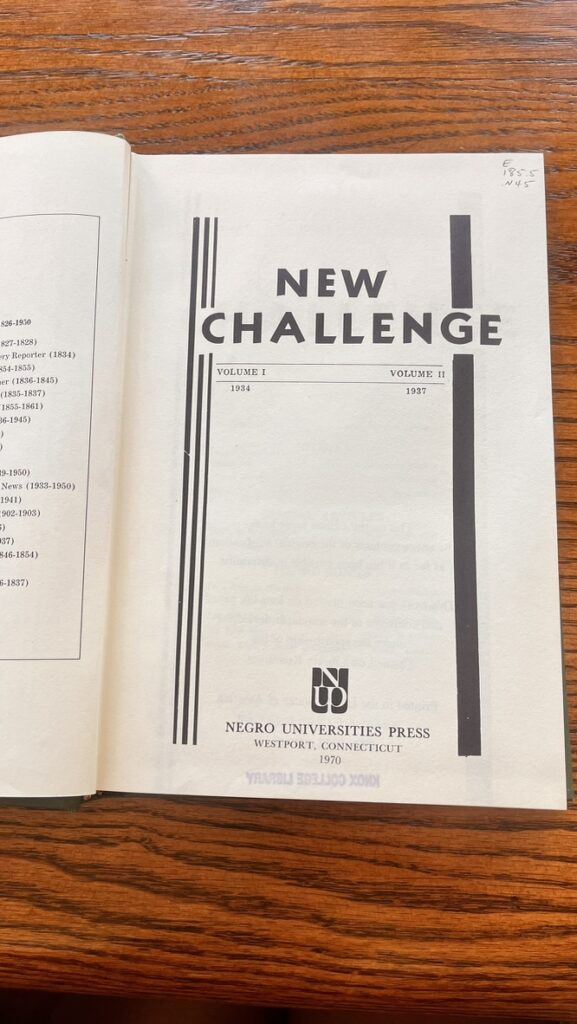
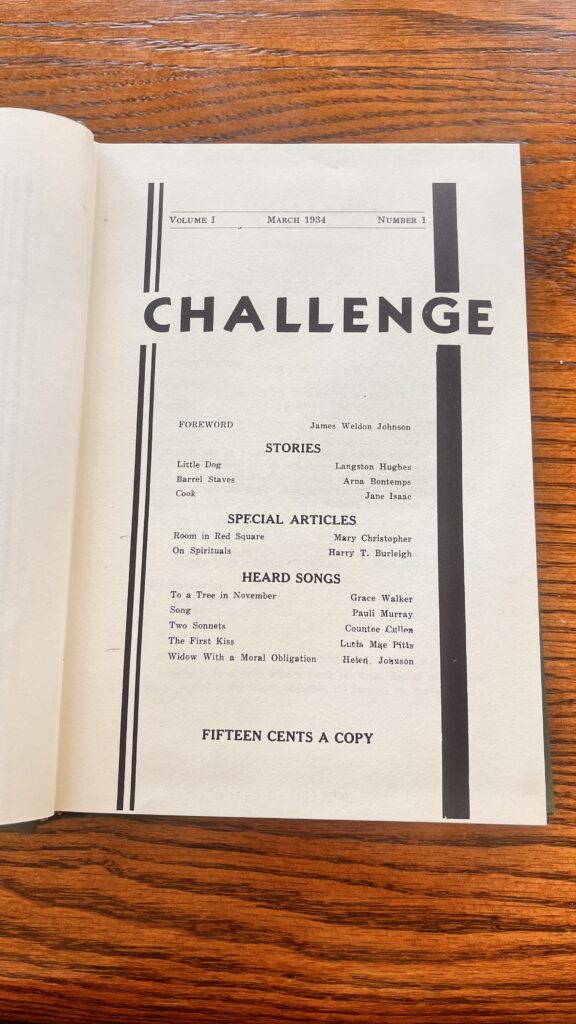
Pictured above is the front matter of the journal “New Challenge” published in 1970, edited by Dorothy West
This journal is made by and for Black Americans of the Harlem Renaissance Era. Magazines and journals that were featured were listed in the front matter. I saw “Crisis” and “Messenger” as other famous magazines and journals that were created to feature Black artists and reach a Black audience at the time.
Discussed throughout are works by artists of many colors discussing topics of Black power, Black liberation/nationalism, racism, and unity. The magazine uses an array of interesting fonts and includes several sections such as news, essays, and poems. It had the look and length of a regular modern book/novel, which differs from the look and feel of a modern magazine. I still find that interesting. I expected a journal or magazine from back then to look like a newspaper.
I recognized well-known artists such as Langston Hughes, Counte Cullen, and Zora Neale Hurston from my study of writers of the Harlem Renaissance. Pictured below is a poem by Countee Cullen that I really liked.
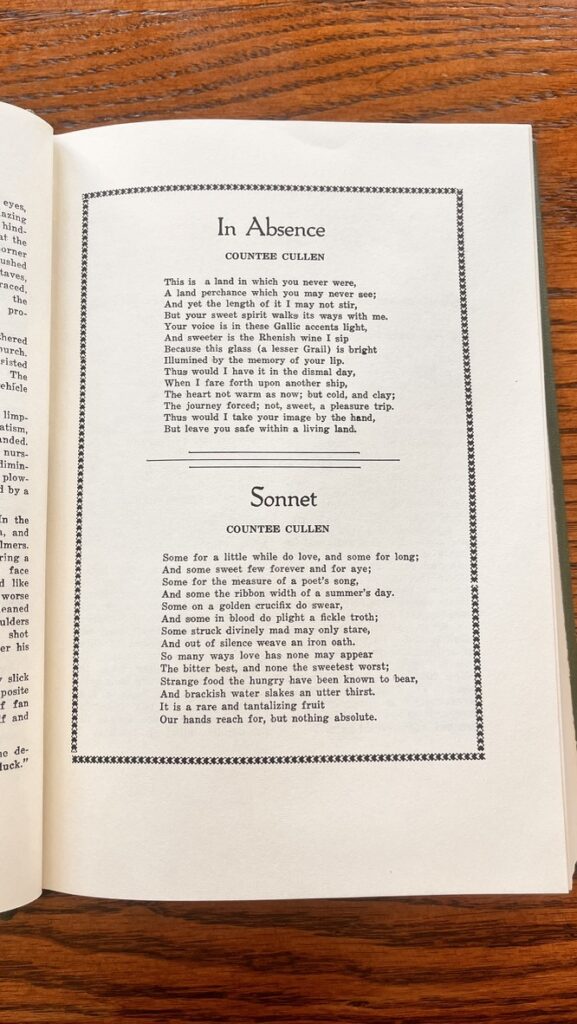
The second is a sonnet by Cullen, titled “Sonnet”. It’s formatted like a traditional sonnet with fourteen lines talking about something romantic with flowery, old-timey language, at least to me. I’m not sure if this counts as something experimental… as it is very traditional and strict. Maybe she does this as a statement. I remember in another class, Langston Hughes reminisced about speaking to a young writer who didn’t want to be a “Black” poet, she just wanted to be a poet. This young poet was theorized to be Countee Cullen. If true, I think she might’ve thought of a Black PoetTM as an African American writer who had to stick to a specific topic with a specific agenda, instead of just…writing about whatever they want. I understand that there might’ve been a lot to live up to and she was afraid to put herself in that category. But I hope that she learned there is hardly any strictness in being a Black poet. To me, she, Langston Hughes, and Zora Neale Hurston are all Black poets for the same reason. They wrote and shared beautiful poetry with an audience of Black people, as Black people, in a time that needed it the most.
Good work, Charlene. Countee Cullen was, in fact, a “he.” But that’s beside the point. I appreciate your deep dive into Challenge. And Cullen’s use of the sonnet, though conventional, was appreciated at the time.