It perhaps comes as no surprise that most of my research on our third day in Seymour Library was simply focused on picking up something random and looking at whatever piqued my interest. Towards this end, I went straight for an actual magazine on my first go and picked up the May-June 1924 issue of The Transatlantic Review (also known as Vol. 1, No. 5). Once I finished up there, I moved on to Volume 25 of Poetry, which encompasses content from Harriet Monroe’s magazine ranging from October-March of 1924-1925.
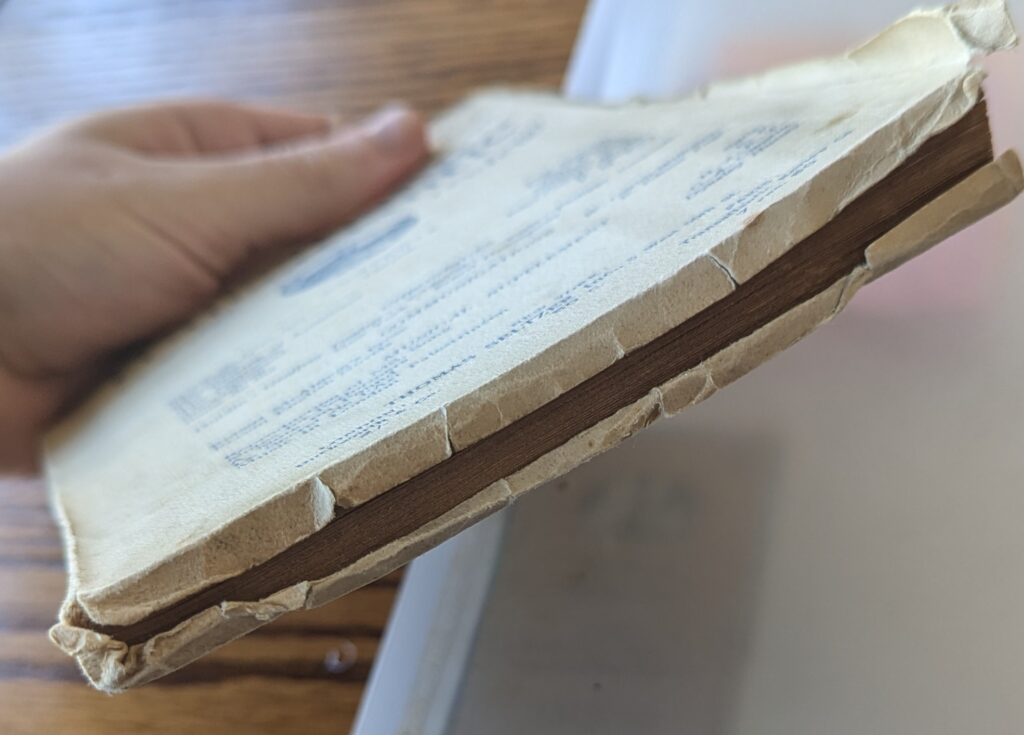
The first thing I noticed about The Transatlantic Review had nothing to do with the content. Rather, I looked at the cover and wondered why it looked like a package that had been ripped open. As you can see with my impeccable photography skills, the tears on either side of the cover line up over the interim pages. I suspect the reason for this is that the magazine really was a package unto itself, with the cover being sealed the whole way around to protect the inner pages over the course of whatever shipping routine (potentially over an entire ocean, hence “Transatlantic” in The Transatlantic Review”) the magazine might have had to endure.
As for the actual contents of Vol. 1, No. 5 of The Transatlantic Review, I once again found something written by Gertrude Stein. This time around, it was an excerpt from a book, The Making of Americans. For those who are curious, her prose is just as difficult to understand as her poetry. Every sentence I read was an enormous run-on, too, and thus my attention span didn’t stand a chance.
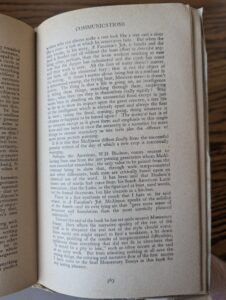
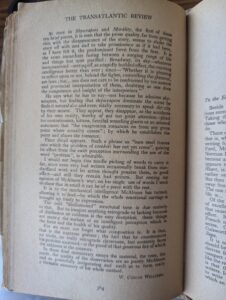
The other thing of note I found in the magazine was a lovely little section called “Communications,” which unsurprisingly included letters from readers. Two letters were included in the section, one of which was from William Carlos Williams on the subject of Robert McAlmon’s prose. Getting a look into his mindset by seeing how he interprets the work of another writer is quite interesting, so I’ve included pictures of his letter below. As per usual, I apologize for any difficulty with legibility and size.
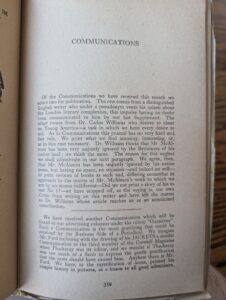
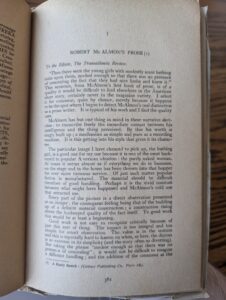
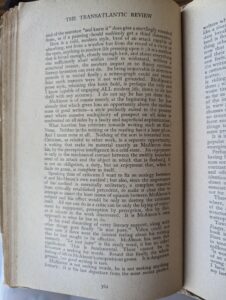
Moving on to Volume 25 of Poetry, there isn’t quite as much to say. Most of the pictures and content I found worth noting came from the “News Notes” section and how they detailed the lives of the magazine’s contributors. As a student at Knox, it is mandatory that I make mention of Carl Sandburg, who is mentioned as, “writing a book about Abraham Lincoln” on a page that my reference photo didn’t include the number of. Otherwise, I discovered that Harriet Monroe (or whoever writes the “News Notes” section) has a spectacular sense of humor, since the entry on William Butler Yeats on page 55 includes the utter gem that is, “Those who know Mr. Yeats’ hand-writing will understand why we refuse to risk further quotation, but by a process of elimination we gather from the rest of his letter…” Is it at all relevant to any discussion? Not really, no. But it’s always fun to read little jabs like these.
Great work, Jack. You really pulled together a fascinating cross-section of modernist print culture; Stein, Williams, Monroe?!