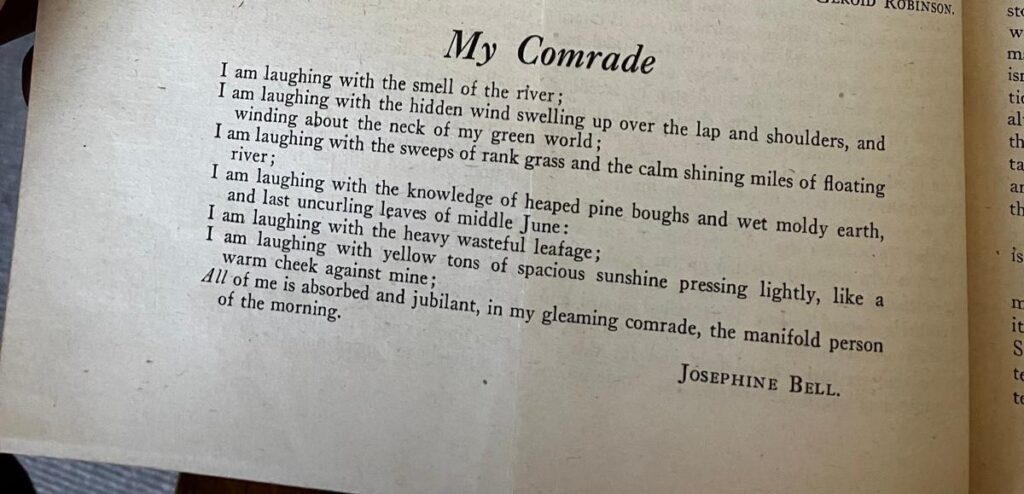
I have hardly talked about poetry yet in these blog posts. Is that not why I am here?
Josephine Bell, from what I can divine from Google, was a pseudonym of Doris Bell Collier. Bell was born on December 8th (my birthday as well!) 1897 in Manchester and died in 1987. As well as a writer, she was a physician. She’s most famous for detective fiction, but dabbled in poetry.
So who is the narrator’s comrade? That is the fundamental question the reader is presented with, upon reading this poem. “All of me is absorbed and jubilant, in my gleaming comrade, the manifold person/of the morning.” Preceded by loads of natural imagery, this kind of leads me to believe perhaps their comrade is the Earth itself. “Manifold” denotes something akin to multi-faceted, having many forms, et cetera, which is certainly true of the Earth. And since there is a sheer amount of varied depictions of the natural world beforehand, I’d be tempted to say that I’m right.
I think an interesting idea we can extrapolate from this is that since radical political standpoints, especially in anarchist spheres, tend to be interested in how hierarchies are working, and could work. Nature has a sort of a hierarchy, what with predator-prey relationships and so forth. You could, in theory, map a food web onto the sort of political-social hierarchies produced by the current or past states of the world. But it will never quite line up because there is a scarcity or deficit produced by the hierarchies we as humans have put into place in our societies. In nature, the hierarchies ensure that everyone gets what they need. One could argue this is how societies work too, but I don’t think Josephine Bell would agree with that.
Great work, Smith. Archival research is so great for getting in touch with writers who may not have become super famous, but we were still part of modernism’s moment.