For Roya Biggie, ENG 251, Knox College

It is an undeniable fact that language develops over time to fit society’s communicational needs and beliefs. Dissecting the evolution of words and where and how they are used is a quintessential literary (and historical) tool. In medieval and early modern works, when literature was a highly esteemed art only accessible to literate (and thereby, educated) persons, exact wording was of immense importance. Thus, medieval literature is not only riddled with words reflective of the period’s grammar (i.e., “art thou”), but also its philosophies, values, and social structures. To discover historical English views on the pursuit of knowledge and the conquering of land, look no further than their usage of “discover” (and other connected words), from long-form epics to sonnets.
According to the Oxford English Dictionary, “discover” comes from the Middle French word decouvrir, meaning to reveal something to one’s sight or to make something known. Interestingly, while English is cited as using the same definition as the French in 1375 (def. I.2.a.), a different definition predates it. In 1330, the OED initially labeled it a transitive verb meaning “to declare or give away the identity of (a person)” or “to betray” (def. I.1.), although this is marked as obsolete. Despite being similar to the 1375 definition, this use gives “discover” much more authoritative action. Moreover, it has a highly negative connotation that is not seen in the literary works discussed in this essay. However, long before either of these examples, “discover” was used in the famous epic Beowulf.
Medieval Literature (8th or 10th Century) : Beowulf
It must be noted that Beowulf was originally written in Old English, and the exact use of “discover” is not present; however, it is unavoidable that it (and many synonyms) appear in translation. Although its author and origin are unknown, Beowulf is widely considered to be the oldest great long English poem, dating back between the early eighth century and the tenth century (A: 37). Epics, especially Beowulf, are grandiose tales of expeditions with revolving themes of voyages and conquest. Their adventurous protagonists (often described as brave and honorable) took treasures from foreign lands, slayed monsters or foes, and/or overcame God-given challenges. In its own right, the popularity of the genre reflects the times’ encouragement of imperialist journeys—an ideology apparent from the beginning of Beowulf. This essay follows Seamus Heaney’s 1999 “New Verse Translation.”1
Courage, greatness, and heroism are all positive adjectives attributed to ruling kings and campaigning princes.2 Indeed, the first three lines alone highly praise monarchies and their imperialist conquests. Moreover, “We have heard” indicates that a large contributor of “greatness” is being known (a.k.a., being discovered by an audience). After all, the lengthy narrative form of an epic supports this interpretation since they are meant to contribute fame and awe to the protagonist. Furthermore, the actual text of Beowulf also demonstrates imperialist values; “Behavior that’s admired / is the path to power among people everywhere” (24-25). Since the first three lines of Beowulf immediately establish that kingly superiority and voyaging princes are admirable, these following lines plainly reveal that the motivation for Beowulf to conduct such journeys is to gain power and control people.
Despite Beowulf revolving around Beowulf’s expeditions, the Heaney translation almost exclusively uses “discover” in instances of learning new information—not seeing new lands or objects. This is on par with the 1375 “make something known” half of the definition. Still, it is a lot less literal than suitable for the time (“discover” would not be attributed to knowledge for centuries—see discussion on Bacon). Although Beowulf is most famously known for slaying the monster Grendel, it is his later encounter with the dragon that most interestingly uses discovery. After defeating Grendel, Beowulf is stated to have then ruled for fifty years (2209). However, Beowulf’s reign is not depicted, and what is instead explored for the one thousand lines is his fight with a dragon. This focus highlights how, in early medieval times, adventure was considered the most appealing aspect of a story.
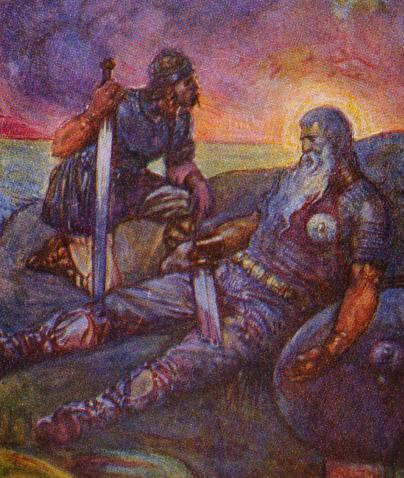
Moreover, despite both Beowulf and the dragon being protectors of land,3 Beowulf does not respect the dragon in any way. Although he was the one initially wronged (a man trespassed into the cave and stole a goblet), the dragon is regarded as a foreign beast that is never named.4 Enraged by this intrusion and robbery, the “savage” (2296) “heathen” (2216) “scoured and hunted” (2294) for the human who awoke him. Initially only angered by his sleep being interrupted (2295), it is when the dragon “discover(ed) / signs that someone had stumbled upon / the golden treasures” (2300-2302) that viciously enrages him. In this instance, ‘discover” conveys the acquiring of new knowledge, not the finding of land or objects (the man didn’t “discover” the cave or the cup). Moreover, it refers to the dragon, giving him5 human-like qualities of intelligence. Not only is he capable of noticing a difference in his stash, but he is also then correctly able to conclude why the goblet would be missing. While it is undeniable that the dragon was the one slighted, Beowulf never suggests that the cup be peacefully returned. Despite his already accumulated fame and wealth, Beowulf wants another fight and to possess the rest of the treasures. This injustice is reflective of European colonization. Foreigners were dehumanized and pillaged after being the initial victims of invasion. Additionally, Beowulf is buried6 with much of the gold. The riches being claimed only to boost his image in death and nothing else is arguably reminiscent of museum displays.7
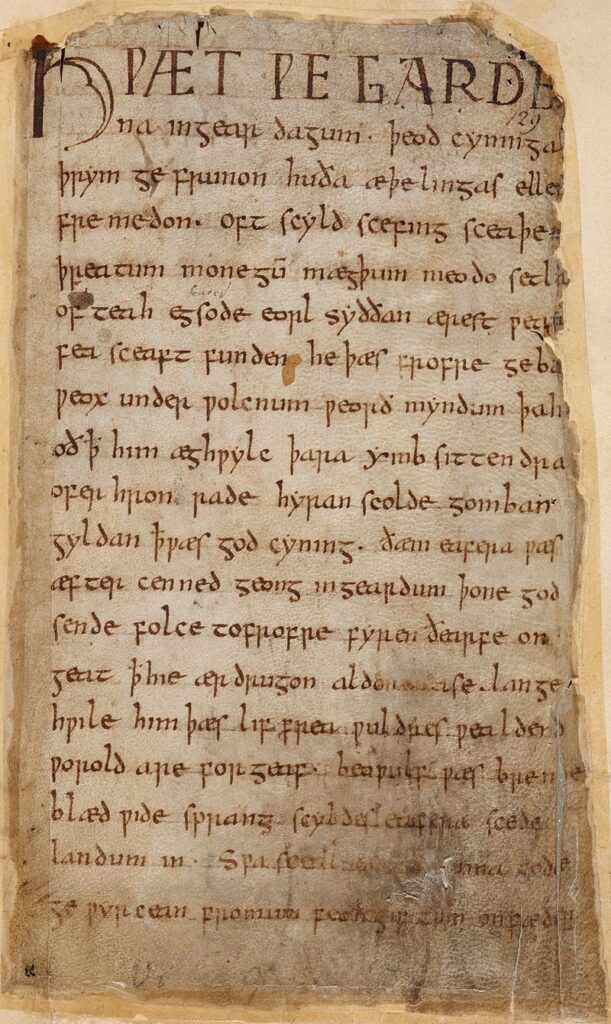
First page of Beowulf.
Wiglaf beside Beowulf during his death, illustrated by J. R. Skelton, 1908.
Medieval Literature (12th Century) : Milun
The French author, known only as Marie de France, is credited with being one of the most influential early medieval poets (A: 159). She wrote in Old French, so translations once again differ. Still, Marie’s use of discoveries in the lai Milun significantly reveals “discover”’s developing connotation of enlightenment and identity. A pioneer of the lai (a genre most commonly read by people of the court), Marie mainly wrote about romances between nobles or other highly esteemed persons (159). While it is very much befitting to intertwine the court with analyses of colonization, proposed parallels to love may be jarring to modern readers. Although addressed in my reading of Milun, this is more explicitly explored in the work of John Donne.
Albeit entirely different from the grandiose epic Beowulf, Milun also revolves around honor and travel. An unnamed noble lady hears tales of a famous Irish knight named Milun and immediately “began to love the man” (26). She then breaks hierarchical rules by sending a messenger8 to profess her love and arrange a meeting between Milun and herself. Mere courageous fame inspiring her to take such a risk is a great example of how positively bravery and power were perceived. While Beowulf never married (nor had any romantic relationship), he won fame and riches from his murderous acquisitions. Milun’s travels never win him a throne, but they win him a noblewoman. With this comparison, he not only obtains proximity to power but also “his amie” (279, 509). This sexist illustration of women as objects is perpetuated by her never being named and only described possessively as belonging to Milun.
The two have a baby, but since it is out of wedlock, the unnamed love interest gives their son to Milun with the instruction of bequeathing the infant to her “married sister” (68) alongside Milun’s ring and a letter. The mother explains that it should be read when their child is grown and capable of understanding (82-83). When this happens, the ring should also be given “so it (the child) may discover / while it cares for these things, its father” (85-86). In this quote,9 “discover” not only pertains to knowledge and identity, but also love and material wealth/possession (via the ring, also a symbol of love). It equates discovery with understanding oneself through objects, thus displaying the twelfth century’s view that discovery and material things lead to enlightenment.
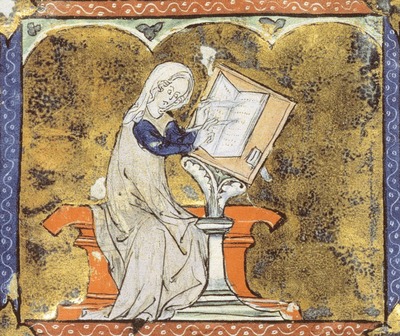
Marie de France from an illuminated manuscript.
Early Modern Literature (16th Century) : Ralegh
Retrospectively referred to as the Age of Discovery or the Age of Exploration, the 1500s and 1600s are characterized by Europe’s rapid colonization of the world. During this time, “discover” appears much more frequently in the Oxford English Dictionary. For the most part, entries are under previous definitions, although two new definitions appeared just before the 16th century. In 1440, it was finally cited in the sense of exploration; “To reconnoitre, survey; (more generally) to explore (a region, country, etc.)” (def. I.3.a.). Additionally, “To reveal a secret; to make a disclosure; to confess” (def. I.2.b.) is contributed to 1450 (although it is noted to have maybe originated in 1420) but is mostly attributed to the late 16th and 17th centuries. “Discover” being connected to exploration and secret10 knowledge (now not just learning information, but information that would make the discoverer part of something special) is apparent in 16th-century literature.
The poet Sir Walter Ralegh11 (1552-1618) is a great display of imperialism being positively12 perceived, especially since he was an active colonizer himself (B: 790). In 1595, Ralegh relayed his mission to find and claim the fabled “El Dorado” (“golden city”) in an exaggerated account called The Discovery of the Large, Rich, and Beautiful Empire of Guiana, with a Relation of the Great and Golden City of Manoa (Which the Spaniards Call El Dorado). Although the title suggests that he succeeded and discovered the famed golden city, he did not. Befitting an essay with such a grandiose title, Ralgeh describes his journey in a manner very similar to an epic. He refers to an armadillo as a “beast” (B: 791) and frames absences in his descriptions of certain animals as acts of kindness (B: 798).13 The text is a perfect display of imperialism being praised and portrayed in a way that makes the colonizer appear impressive and compassionate.
Notably, Ralegh was beheaded in 1618 after a second expedition to Guiana (also a failure) angered the Spanish, whom James I wanted better relations with (B: 791). However, despite being denounced and hated by many people (B: 790), he is not exclusively negatively regarded. In June 1938, literary scholar C.F. Tucker Brooke wrote “Sir Walter Ralegh as a Poet and Philosopher,” a lengthy and positive article on Ralegh. In it, he declared Ralegh’s execution as the death of “the last of the Elizabethan romantics” (Brooke 93). Published right before WW2, it is proof that some people will always romanticize war. Societal values are merely composed of a population’s most prevalent personal opinions.
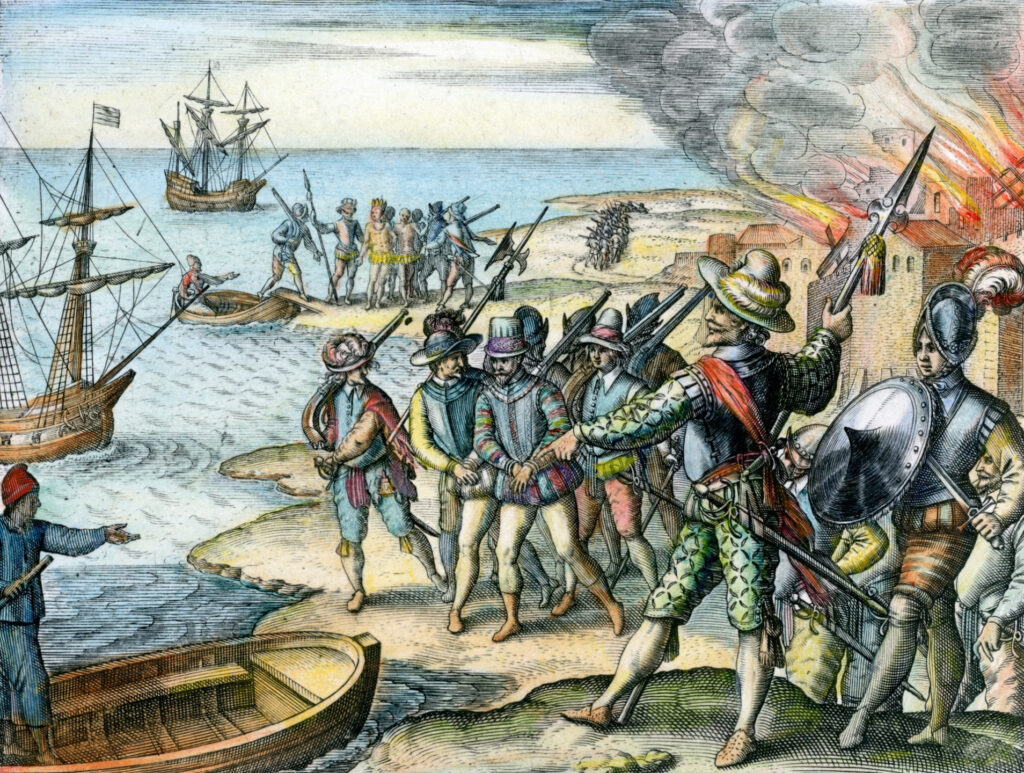
Walter Raleigh at Trinidad.
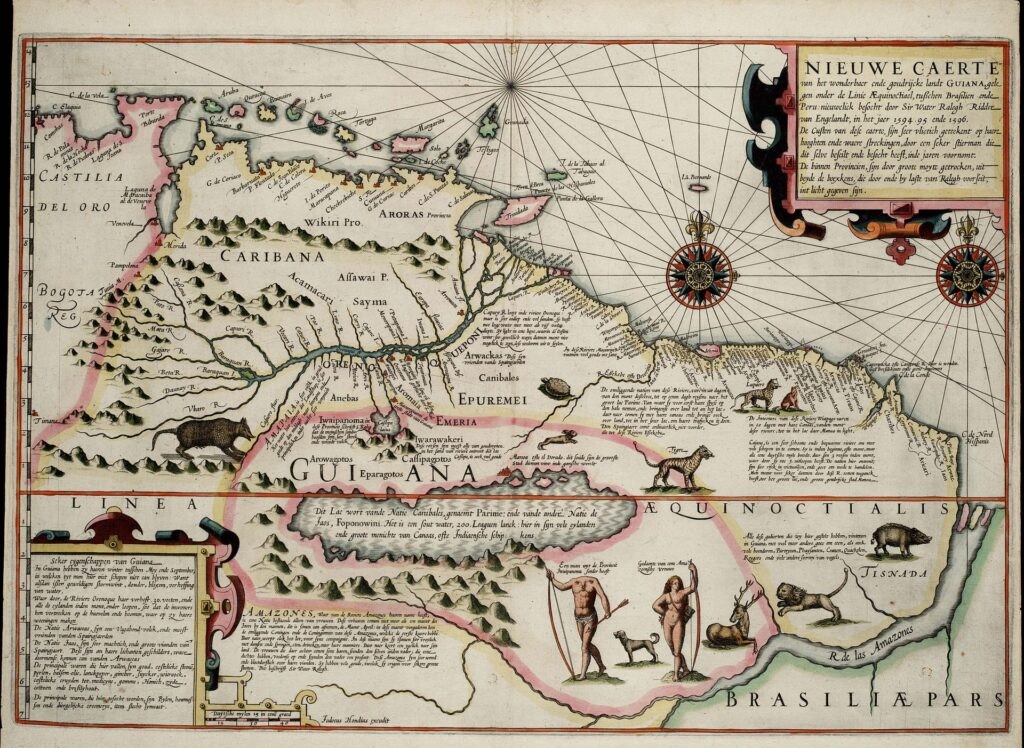
A map of Guiana from 1598, showing Lake Parime.
Early Modern Literature (17th Century) : Bacon & Donne
Similar to Ralegh, positive displays of imperialism can be seen in the work of Sir Francis Bacon (1561-1626) and his frequent use of voyages as a metaphor for the attainment of knowledge and subsequent bettering of the world (Edwards 153). Perhaps Bacon’s most notable literary contribution is his incomplete 1627 science utopia novel New Atlantis, which influenced the English essay and scientific literary genres (B: 1567). Unique of the time, New Atlantis took place in the future and is an expression of Bacon’s belief that discoveries from voyages will lead to an educated world.
Although not included in the Norton Anthology, the 1997 book Sea Mark : The Metaphorical Voyage, Spenser to Milton by English professor and author Philip Edwards highlights New Atlantis’ first instance of “discover” and explains how it is groundbreaking to “discover”’s evolution.
*italics do not adhere to the original form
As suggested by his unique italicization and capitalization, Bacon was not one to adhere to traditional conventions or, apparently, meanings. While the I.2.b. OED definition already cited “discover” as denoting the exposure of a secret, this use was evidently not known to Bacon’s editors, James Spedding and Robert Leslie Ellis. The men allegedly15 took issue with the passage’s employment of “discover,” stating that it nonsensically means God “removed the covering of the face of the deep” (Edwards 158). However, in this quote, “discover” operates as a figurative removal. Bacon is not baselessly inventing a new meaning of the word. Instead, he is extrapolating it from the standard definition. It functions as the uncovering of ignorance and, thus, the finding of hidden knowledge. This use further extends into exploration (for instance, regardless of a land always existing, it was considered not yet “discovered” if it was unknown to others). So, whether or not Bacon was the first person to equate “discover” with “disclose” / “expose,” his continuous application of the word in contexts other than “uncover” undoubtedly transformed the English language. The evolution of language is inherently linked to people manipulating standard perceptions to suit different purposes. After all, its second use feels outdated to modern readers, who would grammatically prefer “we discovered his land.”
A few decades later, John Donne (1572-1631) published the sonnet “Elegy16 19. To His Mistress Going to Bed” (1669). Depicting a man watching a woman undress, it is an excellent example of “discover” intertwining imperialist ideology with the objectification of the female body (an unsurprisingly common theme in medieval work).
These lines use language with notions of dominance, power, and enlightenment. The repeated use of “my” establishes ownership, and by describing the woman as his “kingdom” and “empery,” the monarchical structure of England is present. Although it may deceivingly appear to uplift the woman by comparing her to something as impressive as an empire and regarding her as a “blessing,” it is still unquestionably objectifying. It paints her body as a thing to own and rule over. It is not her that blesses the speaker but the discovery of her body.
Throughout the explored texts, women have been dismissed and dehumanized. Imperialists treated Natives in a similar manner (refer to the reading of the Beowulf dragon and Ralegh). Thus, it can be concluded that medieval and early modern literature used “discover” in a combined sense of knowledge and exploration by often representing oppressed persons as a mysterious thing to claim, educate, and civilize.
Line 27’s reference to Columbus and his “discovery” of the Americas was a common element of 16th and 17th-century literature.
It was relatively common for love sonnets to use conquering as a metaphor.
Not all medieval and early modern authors used discovery to present colonization positively. Some arguably critiqued imperialism.
Margret Cavendish : The unique novel The Description of a New World, Called The Blazing World (1666)is often read as an opposition to colonization due to the word choice surrounding the Empress; "She did also admire... that their greatest glory was in plunder and slaughter" (1377) and the story revolving around the creation and conquering of imaginary worlds rather than the "terrestrial world" (1380).

John Milton : Some regard Milton's work, particularly Paradise Lost (1674), as anti-imperialism; “Milton's voyage imagery was deeply influenced by his opposition to colonialism.... The voyage is always associated with the fallen state of mankind, a restless seeking and searching quite foreign to the life of Eden or Heaven. Real voyages in pursuit of riches and territory were both symbols and examples of the nature of human life as it ought not to be but had to be. Milton stands at the opposite extreme from Bacon in his attitude to voyaging and his use of it as metaphor" (Edwards 210). See Chapter 8 of Sea-Mark for deeper analysis.



- This translation has been contested. See Brown, Calvin S. “On Reading ‘Beowulf.’” The Sewanee Review, vol. 50, no. 1, 1942, pp. 78–86 and McGuire, Thomas. “Violence and Vernacular in Seamus Heaney’s ‘Beowulf.’” New Hibernia Review / Iris Éireannach Nua, vol. 10, no. 1, 2006, pp. 79–99. ↩︎
- The absence of queens and princesses in the introduction is a clear display of the times’ refusal to associate women with the same level of power as their male counterparts. Sexism will be briefly explored in this essay, although it is not the main focus. ↩︎
- The dragon was described as having “guarded” (2213) a “vault” (2212). ↩︎
- This is an ultimate act of dehumanization, especially in medieval epics. The Norton Anthology prefaces Beowulf with “A Note on Names.” ↩︎
- Another human characteristic of the dragon is the fact that he is referred to as “he,” not “it.” ↩︎
- Although the battle ends in a mutual death between Beowulf and the dragon, Beowulf is largely considered the “winner” since he is forever endowed in the dragon’s gold while the beast’s name isn’t even known. The mutual destruction and satirical elements of Beowulf could be interpreted as a critique of colonization. ↩︎
- This parallel is further explored at the informal end of New Atlantis when the speaker is given a tour of future statues honoring various inventors. The only identified statue is Columbus—-the quote is provided at the bottom of the WordPress. ↩︎
- Milun and his love often communicated via unnamed servant messengers, including a dove. The journeys of messengers and their possession of secret love letters intertwine voyages, valuable items, romance, and hierarchy. Additionally, the servants playing the same role as a bird display the dehumanization of those at the bottom of society. ↩︎
- In the scene with the aunt, the text also states, “When she discovered who he was / her loving care was marvelous!” (117-118). ↩︎
- Although Milun predates this entry, secrecy is also a big part of how it uses “discover;” “If by some device she could discover / whereby they two could speak together” (237-238). ↩︎
- Although spelled as “Ralegh” in the Norton Anthology, many other sources spell it as “Raleigh.” ↩︎
- His expeditions were described in a very biased and likely falsified manner: “since the Christians offered to invade his territories and those frontiers, they were all at peace, and traded with one another” (B: 793). ↩︎
- “To speak of the several sorts of every kind I fear would be troublesome to the reader, and therefore I will omit them.” ↩︎
- New Atlantis [iii, p. 129] ↩︎
- I say “allegedly” because Edwards does not explicitly cite where Spedding and Ellis said this, although he does point out that the Bible only used “discover” to mean “uncover.” ↩︎
- Unlike sonnets, elegies do not have a fixed form. They are characterized by serious reflection, often in the wake of death (i.e., they are poems of mourning). The title can be interpreted as indicating a celebratory “death” of a woman’s resistance to sexual advances. ↩︎
Works Cited
Asim Das. “Free Searching Animation.” LottieFiles. 2021.
Barudak Visual. “Free ship 1 Animation.” LottieFiles. 2021.
“Beowulf.” Wikipedia, Wikimedia Foundation, 29 Dec. 2013, en.wikipedia.org/wiki/Beowulf.
Cavendish, Margaret. “The Description of a New World, Called The Blazing World” The Norton Anthology of English Literature : The Sixteenth Century and the Early Seventeenth Century, edited by Stephen Greenblatt, 11th ed. Vol B, W.W. Norton & Company, Inc., 2024, pp. 1364-1381. Print.
C. F. Tucker Brooke. “Sir Walter Ralegh as Poet and Philosopher.” ELH, vol. 5, no. 2, 1938, pp. 93–112. JSTOR, https://doi.org/10.2307/2871611.
Edwards, Philip. “Chapter Seven—Bacon : ‘The Art It Selfe of Invention and Discoverie.’” Sea-Mark : The Metaphorical Voyage, Spenser to Milton, Liverpool University Press, Liverpool, Merseyside, 1997, pp. 151–177.
“El Dorado.” Wikipedia, Wikimedia Foundation, 5 Dec. 2010, en.wikipedia.org/wiki/El_Dorado.
Greenblatt, Stephen. “Beowulf.” The Norton Anthology of English Literature : The Middle Ages. 10th ed. Vol A. New York, NY: W.W. Norton & Company, Inc., 2018, pp. 37-42, 89-109. Print.
Greenblatt, Stephen. “Francis Bacon.” The Norton Anthology of English Literature : The Sixteenth Century and the Early Seventeenth Century. 11th ed. Vol B. New York, NY: W.W. Norton & Company, Inc., 2024, pp. 1156, 1175-1180. Print.
Greenblatt, Stephen. “John Donne.” The Norton Anthology of English Literature : The Sixteenth Century and the Early Seventeenth Century. 11th ed. Vol B. New York, NY: W.W. Norton & Company, Inc., 2024, pp. 882-885, 904-905. Print.
Greenblatt, Stephen. “Marie de France.” The Norton Anthology of English Literature : The Middle Ages. 10th ed. Vol A. New York, NY: W.W. Norton & Company, Inc., 2018, pp. 159-171. Print.
Greenblatt, Stephen. “Sir Walter Ralegh.” The Norton Anthology of English Literature : The Sixteenth Century and the Early Seventeenth Century. 11th ed. Vol B. New York, NY: W.W. Norton & Company, Inc., 2024, pp. 790-814. Print.
Interactive Warriors Studio Pvt Ltd. “Free Telescope Animation.” LottieFiles. 2021.
“Marie De France.” Wikipedia, Wikimedia Foundation, 9 May. 2012, en.wikipedia.org/wiki/Marie_de_France.
Mohsen Zamani. “Free Fire Animation.” LottieFiles. 2021.
Oxford English Dictionary, “discover.”
Wroth, Mary. “16.” The Norton Anthology of English Literature : The Sixteenth Century and the Early Seventeenth Century, edited by Stephen Greenblatt, 11th ed. Vol B, W.W. Norton & Company, Inc., 2024, pp. 1075. Print.
Wyatt, Thomas. “The Long Love That in My Thought Doth Harbor.” The Norton Anthology of English Literature : The Sixteenth Century and the Early Seventeenth Century, edited by Stephen Greenblatt, 11th ed. Vol B, W.W. Norton & Company, Inc., 2024, pp. 122. Print.
* all images are in the public domain