“Silence” as it appeared in the October 1924 edition of The Dial
The first impression I got reading Marianne Moore’s “Silence” was that the poem was about childhood – the opening line of “my father used to say” sets a tone of reminiscence. From there, my initial interpretation was that she was weighing this quote against her own childhood. “Superior people never make long visits” is a difficult thing to hear from a parent – given that you live with them for the entire front half of your life. “The deepest feeling always shows itself in silence” – again, heard from a parent, someone who’s meant to listen to you while growing up. With the final line, “Make my house your inn // Inns are not residences” sealing the deal, the poem seemed to me to characterize a precarious childhood with her father. You can imagine I was a bit thrown off, then, when I moved on to doing a bit of research to understand the poem better and learned that Moore never met her father.
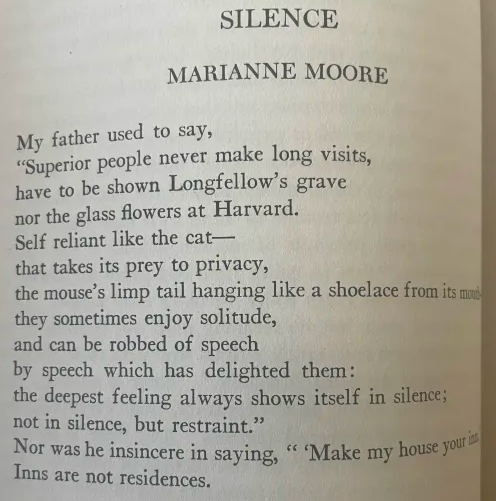
No, Marianne never directly heard her Father say this quote, let alone any quotes, ever – he had a mental breakdown spurred on by religious fanaticism which separated her parents and landed him in an insane asylum, which it’s said that Marianne, nor her mother and brother never visited. Marianne herself admitted in an interview that she did not even learn what he looked like until she was already middle-aged, and he had long since died. This makes the poem far more open-ended, then: who is she weighing this quote against, exactly? We have a few options: perhaps Marianne is still weighing this quote against her own childhood, just in a different capacity. Maybe through this, she means to compare her father to her mother? I’d hear you out on that reading as well, albeit tentatively. To me the subject the quote is being weighed against is a bit obvious – it’s her father. “Superior people never make long visits” – indeed, his presence in her life was no long visit itself. The lines about being robbed of speech and feelings showing themselves in silence/restraint are easy to tie to this reading as well. Again, though, I’m a bit lost as to what the lines about Longfellow’s grave and the glass flowers at Harvard are meant to evoke. My best guess is, noting that the poem only says “shown”, the guests do see these things. They simply seek them out themselves rather than being guided to them. However, as my research continued I then found out that this quote isn’t even attributed to Marianne’s own father – she is paraphrasing an interview with one Miss AM Homans of Wellesley College, in which Homans spoke about her own father. At this point I was completely trounced – and to be entirely candid with you, I did ramble a bit more after this point, but WordPress just crashed and I lost the entire paragraph. Given how little of it I remember it surely wasn’t important – let’s just move along to the drawing.
(The opening paragraph relies heavily on https://www.lrb.co.uk/the-paper/v37/n23/mary-kay-wilmers/what-a-mother)
(The information on the Homans interview can be found here https://www.theguardian.com/books/2023/jul/10/poem-of-the-week-silence-by-marianne-moore)
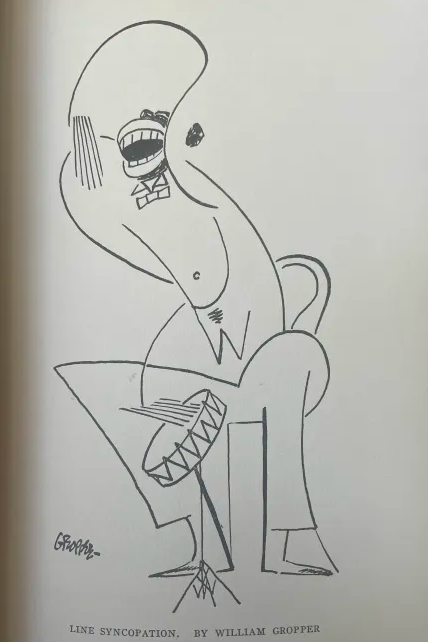
Here is the accompanying drawing for Moore’s Silence – which must be considered, given that Silence as it appeared in the October 1924 edition of The Dial was its first publication (I learned this from the same article where I learned about the Homans interview). Immediately it runs counterintuitive to the poem’s title – it depicts a figure in formal wear implied by a discernable bowtie, collar, and dress shirt hem. The figure is seated – the stool it sits in is only implied via negative space. Its only discernable facial feature is a mouth frozen in a wide-open shout. One of its arm-like appendages beats on a drum which is positioned and angled such that the phallic appearance of it seems at least partially intentional. Its other arm is raised in a melodramatic arch over its head. To nail down exactly what is intended by this drawing’s inclusion is difficult. If we want to over-rely on the poem, it most certainly cannot be in league with those silent, self-reliant, and most importantly ephemeral “Superior people”. It is undeniably loud, we get the impression through its exaggerated size and harsh, bold linework that its presence is enduring, and while it is a stretch, I would even argue against interpreting this figure as self-reliant: its permanently-shouting mouth and overzealous arm gestures almost imply an infant in distress. If it isn’t one of the superior people, then, should it be directly related to the poem, this drawing must depict the “Father” figure. Even then, is this figure the detached “my father” of the poem – I no longer am certain the speaker is Moore – or is it Moore’s father? My personal interpretation is that this figure is meant to represent Moore’s father, since that reinforces my personal reading that the quote in the poem is being weighed against his own actions – even if it isn’t exactly his words.
Good work, Valerie. Except I can’t see the images. They’re coming out too small. Can you fix them?