When we met in the Seymour Library last Friday and thumbed through a handful of magazines that were published during the modernist movement in literature, I will admit that my considerations were rather elementary in nature. So elementary, in fact, that I couldn’t even read most of the only magazine I was able to get to. As you can imagine, this made any actual progress in the realm of investigation somewhat difficult. There is a reason for this, however: the magazine was almost entirely in German.
My estranged attempts at trying to be elusive with the subject aside, the magazine that I looked at last week was the 1931 edition (if there was a month, I didn’t see it) of Omnibus. Most of the contents are written in German, but there were a few pieces of literature that were written in English. The two pieces worth mentioning here are Gertrude Stein’s “If I Told Him, A Completed Portrait of Picasso,” and Alfred H. Barr jr.’s “Paul Klee.” The former piece’s relevance to our course is obvious, given that we’ve already discussed Stein at length with her collection, Tender Buttons. The latter piece’s relevance is less obvious, but I’ll get around to explaining it in a moment.
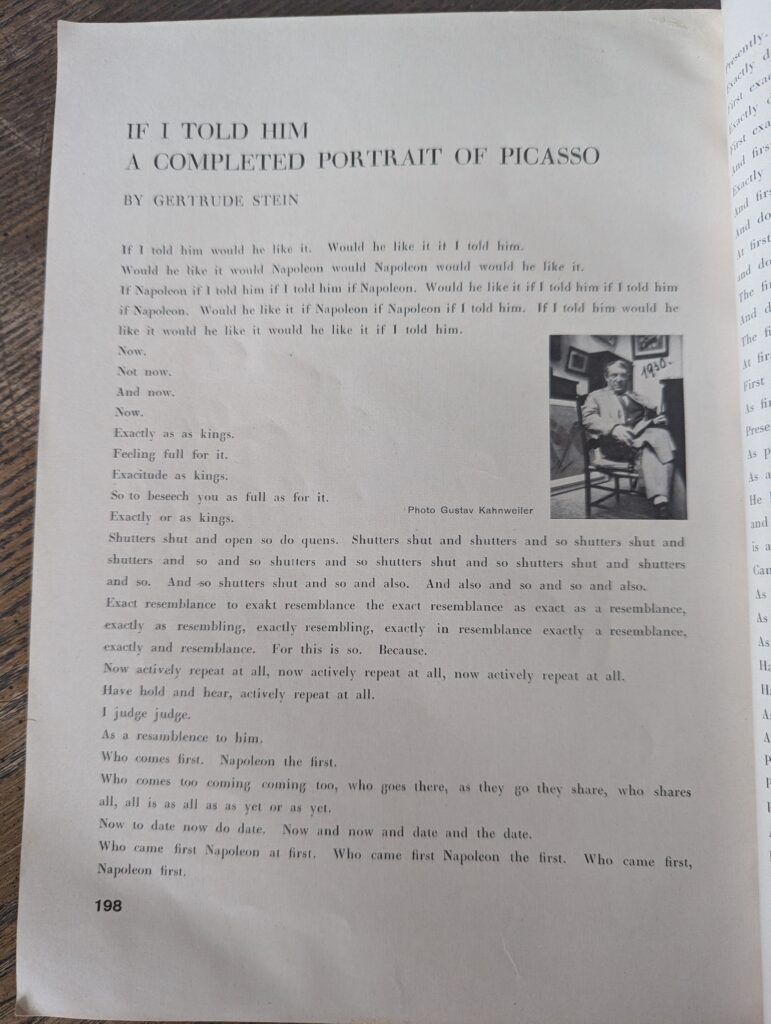
https://www.poetryfoundation.org/poems/55215/if-i-told-him-a-completed-portrait-of-picasso
In and of itself, the subject material of “If I Told Him, A Completed Portrait of Picasso” is emblematic of the modernist literary movement and its connection to similar artistic movements at the time, especially cubism. The poem itself is… definitely something that Stein would write, and we’ve already read about the connection between her and Picasso as people. Thus, it stands to reason that, whatever Stein was trying to say about Picasso (and however Napoleon comes into play with that), her intentions were likely of a personal nature. Stein wasn’t just writing about Picasso as a distant professional in a relevant field, she was writing about him as a close associate.
This is to say that such connections, ranging from the goals of separate movements to the relationships between individuals, weren’t just background details that were only discovered on some ancient stone tablet that was recently unearthed. Those connections were of constant relevance to the public awareness at large, with the modernism and cubism movements constantly intermingling to change and empower one another. We (or, at the very least, I) tend to consider most subjects in a vacuum. Becoming aware of outside connections that both impact and are impacted by the literature we study is an uphill battle – something that I think Professor Tracy recognizes and is trying to accommodate for with the prompting of archival research.
It’s at this point where I’ll briefly return to the second piece I mentioned, Alfred H. Barr jr.’s “Paul Klee.” It’s a biographical piece on the subject of Paul Klee, a notable artist of the time. In many ways, the piece of prose is similar to Stein’s poem in its connection between the literary and artistic movements. I’m realizing as I write that there’s not much more to it than that, other than that the piece was written in English and thus something I could read and understand right off the bat.
So, was there anything else of interest with this mostly German literary magazine that was published 93 years ago? I recall seeing a piece from Earnest Hemingway, but my interest is more likely than not to go elsewhere as we progress in our archival research. That being said, for those who are curious, the Omnibus literary magazine might be worthwhile if you want to examine the modernist movement on a worldwide scale, or even if you just want to see how the movement translates into another language (presuming, of course, that the German pieces present are actually related to the modernist movement). Either way, it serves as an excellent shift in perspective from our mostly American-based studies.