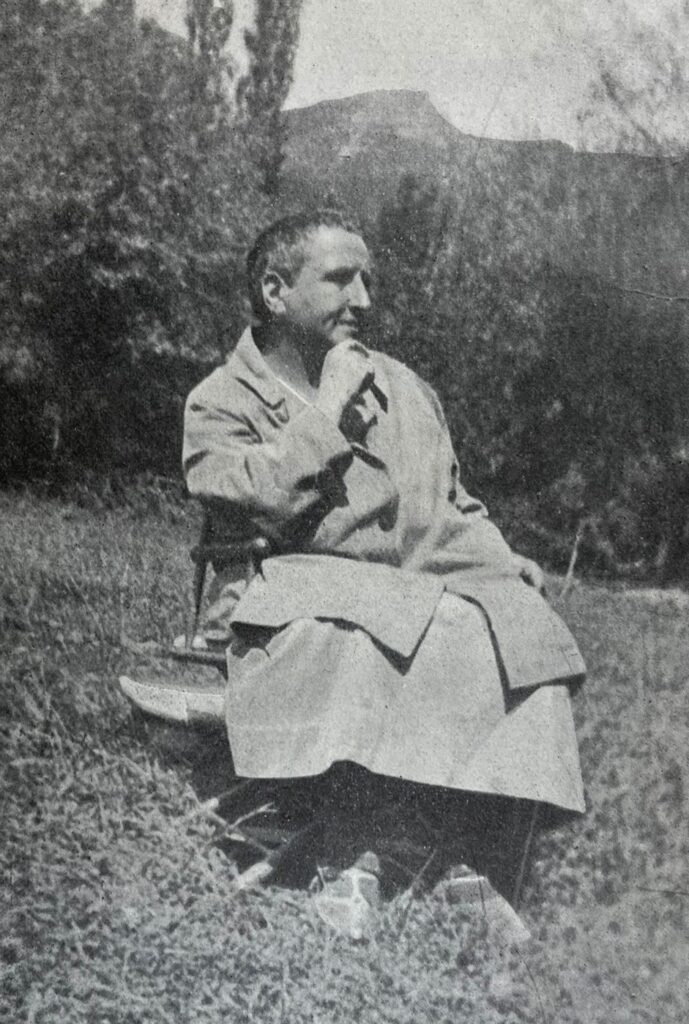
Although published at 40 Rue Fabert, Paris, France (on the bank of the Seine), the Fall 1928 edition of Transitions was entirely in English. As we observed throughout this course, many modernist poets of this period lived and studied in France, including the star of this issue, Gertrude Stein. An important influence of Parisian modernist poetry, Stein lived in the city from 1903-1946, and people from all over the world visited her. Clearly, Transitions shares this awe of Stein since, despite having already published Tender Buttons 14 years prior, the magazine enthusiastically reprinted it. While Tender Buttons underwent many edits, birthing multiple versions, interestingly, there was no indication that the two were different. Additionally, when I compared it with what we read for class, I spotted no noticeable variations (although, of course, I may have missed some). Furthermore, Tender Buttons was reprinted in its entirety at the start of the issue, alongside a photo of the poet herself. This indicates that, at least to Transitions, her work was so important that not only are they honored to “reintroduce” the work after it had been out of circulation, but that both she and her poetry are so revolutionary that they deserve to be front and center of the movement.
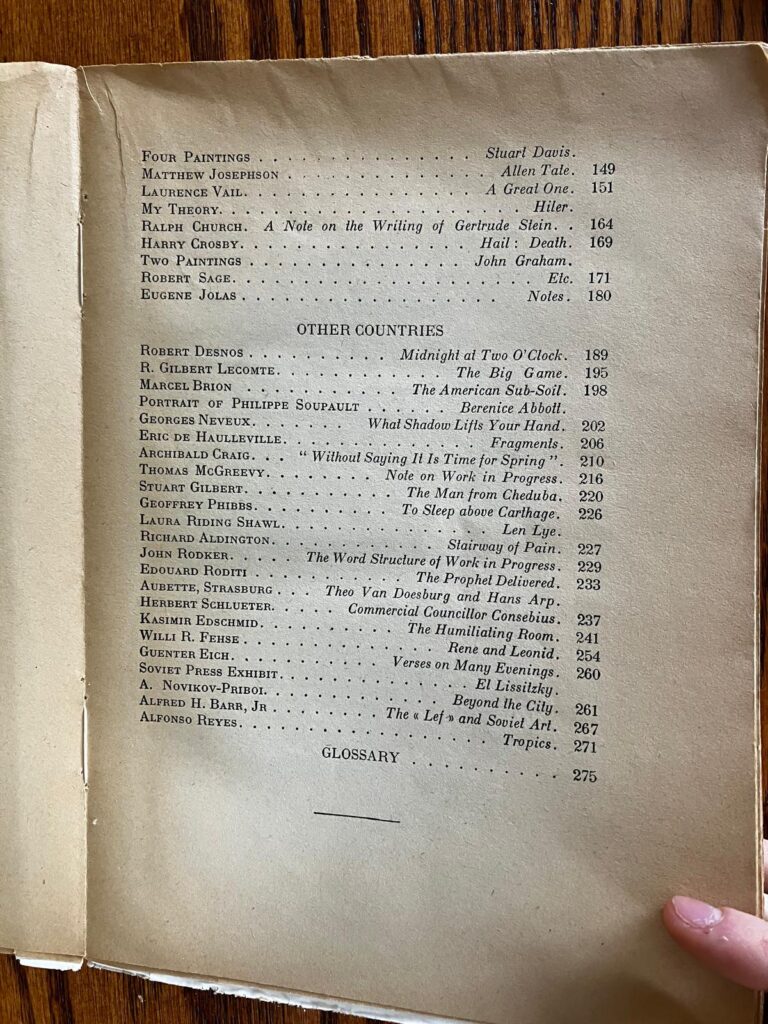
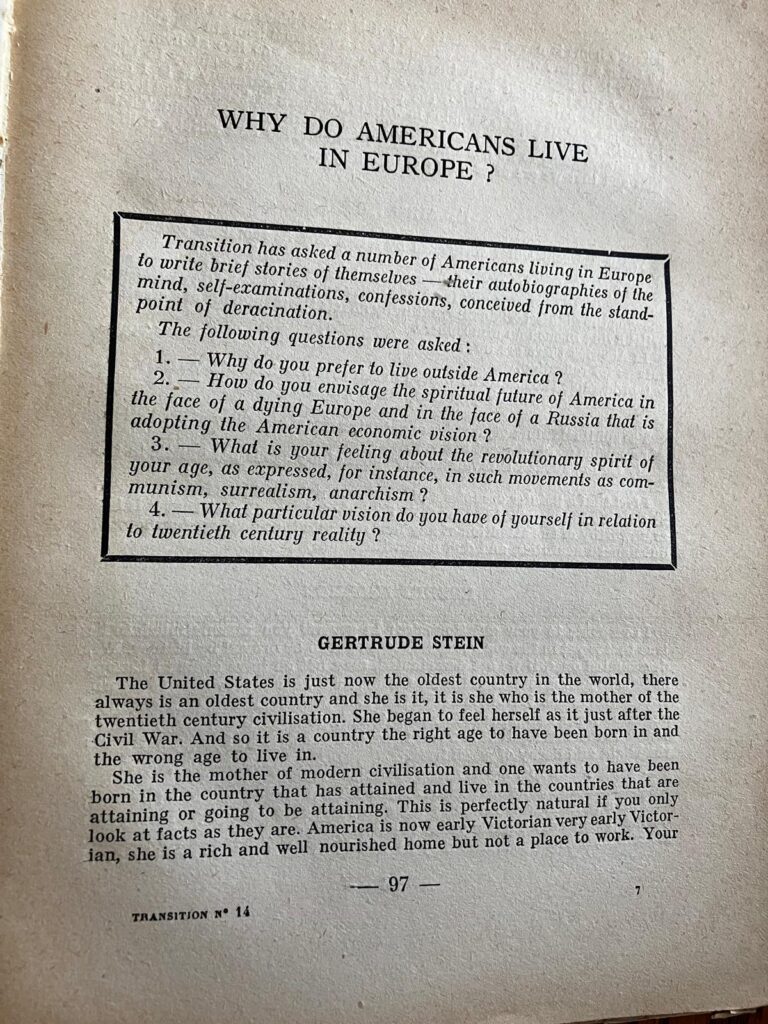
While other voices are featured, none come close to the extent to which Stein is. Not only is no other book fully reprinted, but Tender Buttons is not the only way Stein is included in this magazine. Interestingly, Transitions boasts about highlighting two continents, “America” (which is seemingly mostly, if not all, comprised of work from the United States) and Europe. However, the table of contents does not indicate what specific countries are being represented. In fact, it says “America” and “Other Countries.” The use of “other” here suggests that their use of “America” means that of the country, not the continent. Thus, although Transitions is based in France, there is nowhere near the same attention given to their country or even continent when it comes to crediting the modernist movement. Furthermore, “Why Do Americans Live In Europe” is an entire section with responses from various figureheads. At this point in the blog, you should not be surprised to learn that the first answer featured is Gertrude Stein’s.